Choosing the Optimal Maps for Your Product: A Comprehensive Guide

Introduction: The Critical Role of Maps in Business
In today’s digital landscape, maps are no longer just static tools for navigation. They are a fundamental and dynamic component of any location-based service, serving as the central nervous system for products in industries like ride-sharing, logistics, food delivery, and last-mile operations. A well-chosen map solution can be a key differentiator, enhancing user experience, streamlining operations, and driving business growth. Conversely, a poor choice can be a critical point of failure. Issues such as inaccurate data, missing Points of interest (POIs), or high API costs can directly lead to bad user experiences or significant financial burden, potentially undermining even the most innovative products. Navigating the complex ecosystem of map providers and figuring out the most optimized map solution for your product is therefore not a luxury, but a strategic necessity.
This report will explore the key players in the map ecosystem, from global to regional providers, and dive into the crucial factors that businesses must consider when selecting the right solution for your web/app-based products.
1. The Landscape of Commercial Map Providers
For global and regional coverage, commercial map providers offer robust, feature-rich solutions backed by extensive data collection and frequent updates. They provide a comprehensive suite of datasets, APIs, and SDKs designed for enterprise-level applications.
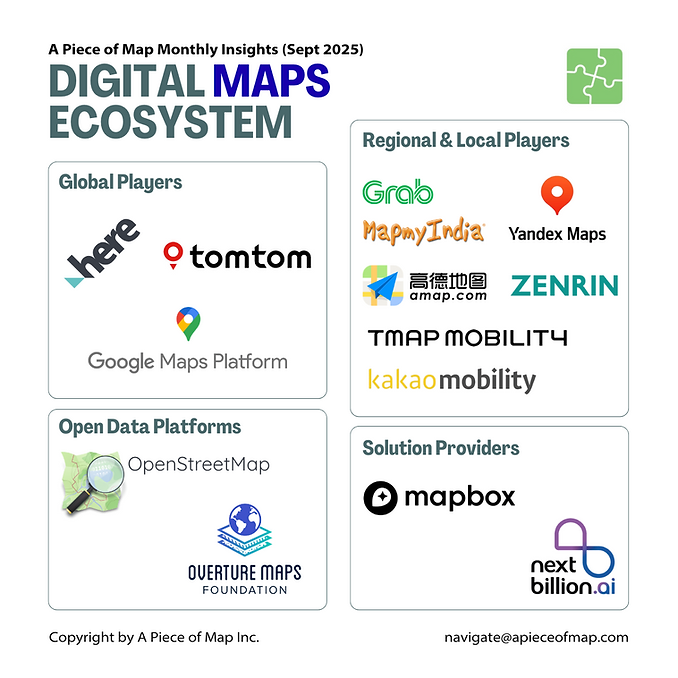
Global Players
- Google Maps Platform: Google Maps Platform is renowned for its global coverage, user-friendly interface, and vast repository of POIs. Its product line includes APIs for Maps, Routes, and Places, offering everything from basic map display to complex route optimization and geocoding. Its strong ecosystem and frequent updates make it a safe choice for many applications, and it easily becomes the first choice for startups. Google’s pricing operates on a pay-as-you-go model with a monthly credit, making it flexible but potentially costly at high usage volumes as the business grows.
- HERE Technologies: With a strong legacy in the automotive and logistics sectors, HERE is a major player known for its highly accurate map data, particularly in complex navigation scenarios. Their services are built to support B2B solutions, offering specialized APIs for fleet management, supply chain optimization, and highly detailed offline maps. HERE is often serving as a preferred alternative for companies seeking to avoid a competitor’s platform or requiring more granular control over data.
- TomTom: A pioneer in GPS navigation, TomTom has evolved into a full-service location technology company. Their platform is a direct competitor to Google and HERE, providing APIs for Maps, Traffic, and Navigation. TomTom is particularly known for its real-time traffic data, which is collected from millions of connected vehicles and devices. Their APIs are a strong choice for applications where precise and up-to-the-minute traffic information is mission-critical.
Regional and Local Players
Beyond the global giants, a number of powerful regional and local providers have emerged to address the unique mapping challenges of their specific markets. These companies often possess highly granular, hyperlocal data that global providers may lack. For example, Grab has developed GrabMaps, a hyperlocal solution for Southeast Asia built on its fleet of drivers to accurately map narrow alleyways and other hard-to-find locations. Similarly, MapMyIndia (Mappls) is the dominant player in India, with highly detailed data on local infrastructure. In China, Amap (Gaode Maps) is the leading provider, integrated deeply into the Alibaba ecosystem, offering specialized services for real-time traffic and public transit. TMap and Kakao are top navigation services in South Korea, leveraging vast mobile network data for precise routing. In Japan, Zenrin has the highest market share due to its strength in detailed address and road network data collected from the real world. In Russia, Yandex Maps is the primary service, with a focus on detailed local search, public transport, and traffic information. These players are often the best choice for businesses operating exclusively in their respective regions.
2. The Rise of Open Source and Collaborative Maps
The open-source movement has significantly impacted the mapping world, offering a powerful alternative to commercial platforms. These initiatives are built on community contributions and provide a high degree of flexibility and cost-effectiveness.
- OpenStreetMap (OSM): OSM is a collaborative project to create a free, open, and editable map of the world. Founded in 2004, it is a powerful foundation for developers who need to build custom mapping solutions without the constraints of commercial licenses. Its data is licensed under the Open Database License (ODbL). This “share-alike” license permits free use, adaptation, and distribution, but requires users to credit OpenStreetMap. If you create a “derivative database” by building upon or altering the data, you must also make the result available under the same license. While the data quality can vary by region depending on community activity, its open-ended nature allows for unprecedented customization and integration with proprietary datasets. Businesses can use OSM data by hosting it on their own servers or by using a third-party service provider.
- Overture Maps Foundation: Launched in December 2022, the Overture Maps Foundation is a new and significant player, a collaboration between major technology companies like Amazon, Meta, Microsoft, and TomTom. Its goal is to create a high-quality, interoperable, and easy-to-use open map dataset. The foundation aims to overcome the challenges of integrating disparate open data sources by creating a common data schema and a global reference system. Overture leverages data from OSM and other sources to create a new, curated dataset that is validated and structured, providing a more reliable foundation for commercial use.
3. The Role of API and SDK Solution Providers
A third category of players exists who do not create their own base map data but instead specialize in building powerful applications and services on top of existing data.
- Mapbox: Mapbox has carved out a niche as a developer-centric and highly customizable mapping platform. Unlike other providers that offer pre-packaged map styles, Mapbox provides tools like Mapbox Studio, allowing developers to create unique, branded map experiences. This makes it a popular choice for businesses where aesthetics and custom styling are a top priority, such as in consumer-facing mobile apps. Their offerings include a wide range of APIs for mapping, navigation, and geocoding.
- Nextbillion.ai is a company that focuses on solving complex location problems for businesses, particularly in logistics and mobility. Their strength lies in their “map-agnostic” approach. They integrate data from various sources (commercial, open source, or proprietary) and use machine learning to build highly customized routing, dispatching, and geocoding solutions. This allows businesses to use the best map data for each region while leveraging a single, powerful platform for their application needs, optimizing for factors like cost, accuracy, and local regulations.
4. Key Considerations for Your Map Strategy
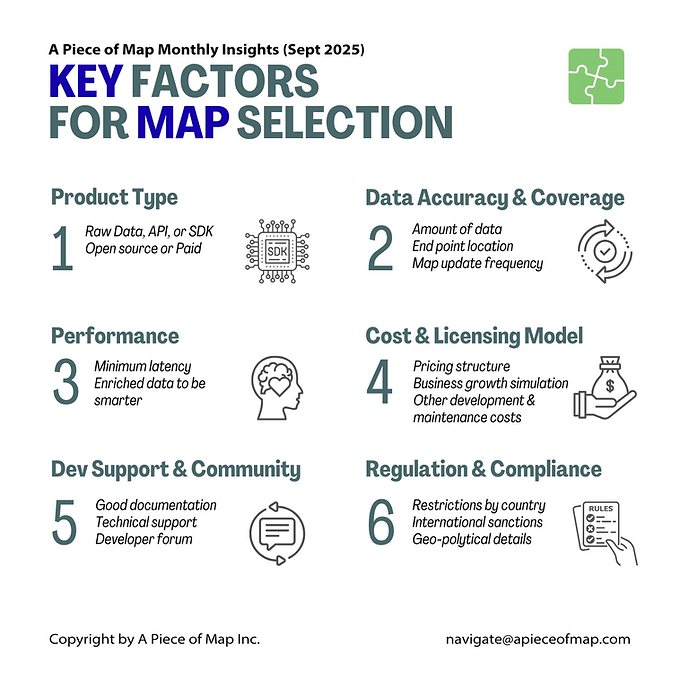
Choosing the right map solution is a multi-faceted decision that requires a careful evaluation of various factors:
- Product Type (Data, API, SDK, Others): Determine if you need raw map data to build a custom solution from scratch, pre-packaged APIs for common functions, or a full-featured SDK for mobile app development. The choice depends on your technical resources and the level of customization required.
- Data Accuracy and Coverage: Ensure if the map data is accurate and up-to-date for your target market. This requires evaluating factors like road network completeness, the number of POIs and their end point locations, and address geocoding accuracy, especially for last-mile delivery and ride-sharing services. The frequency of map data updates is also important for reflecting the fast-changing real world to your products.
- Performance: Stable performance is paramount for high-volume applications like on-demand mobility services, where a smooth user experience is critical. It is also critical that the product runs without latency or downtime in order to ensure users receive accurate ETAs and optimal routes in a timely manner. Moreover, a Navigation SDK’s performance is enhanced when it is enriched with real-time traffic flow, incident and event data, and historical traffic flow statistics.
- Cost and Licensing Model: Understand the pricing structure, whether it’s pay-as-you-go, subscription-based, or volume-based. Evaluate potential costs at scale, and consider the total cost of operations, including developer time and maintenance as your business grows.
- Developer Support and Community: Access to robust documentation, developer forums, and technical support is crucial for smooth development and stable operation. For open-source projects, a vibrant community in your geographical coverage can be a key asset.
- Regulatory and Geopolitical Compliance: It is crucial to be aware of and comply with a country’s specific regulations regarding geographic data. Some countries, such as China, have strict regulations that limit non-local companies from conducting their own map-making activities. In other cases, like South Korea, regulations may require that all geographic data be hosted on servers located within the country’s territory. Additionally, geopolitical factors, such as international sanctions, can prevent map providers from selling their products in certain regions. Neglecting these regulations can lead to significant legal and operational issues.
Conclusion
The map ecosystem is more diverse and dynamic than ever before. Choosing the right mapping solution for your product is a strategic decision that goes far beyond a simple choice between one or two major providers. It involves a careful balancing act of data quality, cost, functionality, and customization. The optimal solution is not one-size-fits-all but is unique to your product’s specific needs, target users, and business model.
A Piece of Map Inc. understands these complexities and can help you navigate this intricate landscape. We provide expert guidance and a comprehensive selection of mapping options, enabling you to secure the best fit for your product at the minimum possible cost, with the convenience of a single contract. By carefully considering all the factors outlined in this report, you can ensure your map becomes a strategic asset, not a hidden liability, for your business.
For more information or customized advisory, please contact navigate@apieceofmap.com.