Online Map, Evolving into ‘Conversation’ and ‘Creation’ Beyond Search
A Comparison of AI Agent Strategies Among the Top 3 Global Map Companies
Historically, the application of AI in the mapping industry was confined to the backend: how to produce maps faster, more accurately, and more efficiently. With the rise of end-to-end AI in autonomous driving—some of which claim to operate without High-Definition (HD) maps—there were even fears that traditional maps might become relics of the past.
However, as long as our social fabric relies on logistics, mobility, and travel, maps remain the engine that keeps the world moving. The recent AI trend among global map leaders has shifted from production to a software and interface revolution for the user.
The keywords driving this shift are Generative AI and MCP (Model Context Protocol). While users of the past—and indeed, most users today—open an app and type keywords to Search, future users (and early adopters) voice their intent to an AI to Solve. Global map platforms are redefining maps from simple databases into Conversational Interfaces that connect humans with the world.
This report analyzes how Google Maps, Mapbox, and TomTom are leveraging AI Agents to enhance user convenience and pioneer new business frontiers.
MCP (Model Context Protocol)
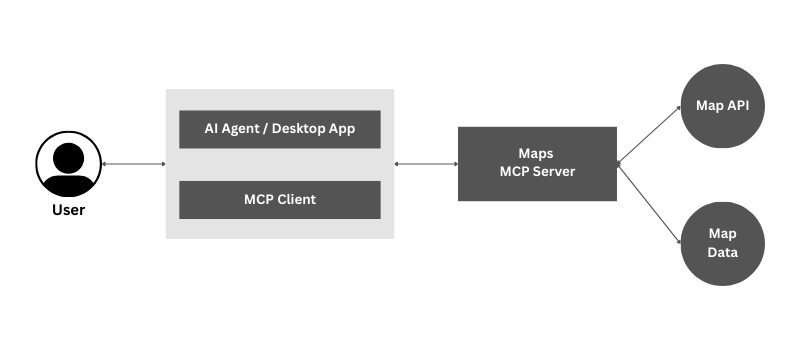
MCP is an open standard protocol that helps AI models communicate safely with external systems and data. Think of it as a universal adapter for AI—much like a USB port that instantly connects a mouse or keyboard to a computer without complex custom coding.
Large Language Models (LLMs) like Gemini or ChatGPT excel at language and reasoning but lack physical context. They don’t inherently know “real-time traffic in Manhattan” or the physical sensation of a “10-minute drive.” MCP acts as the standard that allows these AI models to plug directly into a map company’s server. It enables the AI to access precise coordinates, real-time routes, and POI data as Tools.
The moment MCP is connected, the text-bound AI gains ‘Spatial Intelligence,’ allowing it to finally read and interpret the map.
Google Maps: The Everyday ‘Super Agent’
Leveraging its robust foundation in AI, productivity tools, and cloud ecosystems, Google is transforming the mapping experience across all fronts: General Users (B2C), Automotive, and Developers (B2B).
1. General Users (B2C): Shifting to Context-Aware Multimodal Conversation
- Conversational Navigation: Moving beyond simple commands like “Find a restaurant on my route,” Gemini now understands complex contexts such as, “Is there a brunch cafe with outdoor seating that’s good for a group of friends? How’s the parking?” It summarizes reviews and connects directly to reservations, aiming for a seamless mobile experience.
- Visual Intelligence: Integrating visual data into the map environment, the AI can recognize buildings through the camera lens (e.g., “This is a bar famous for cocktails”), blending text and vision.
2. Automotive: Connecting Visual Perception with Map Data
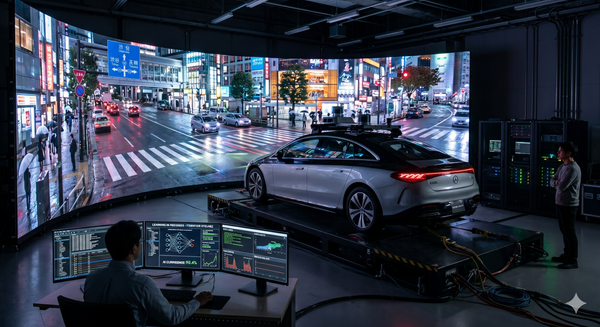
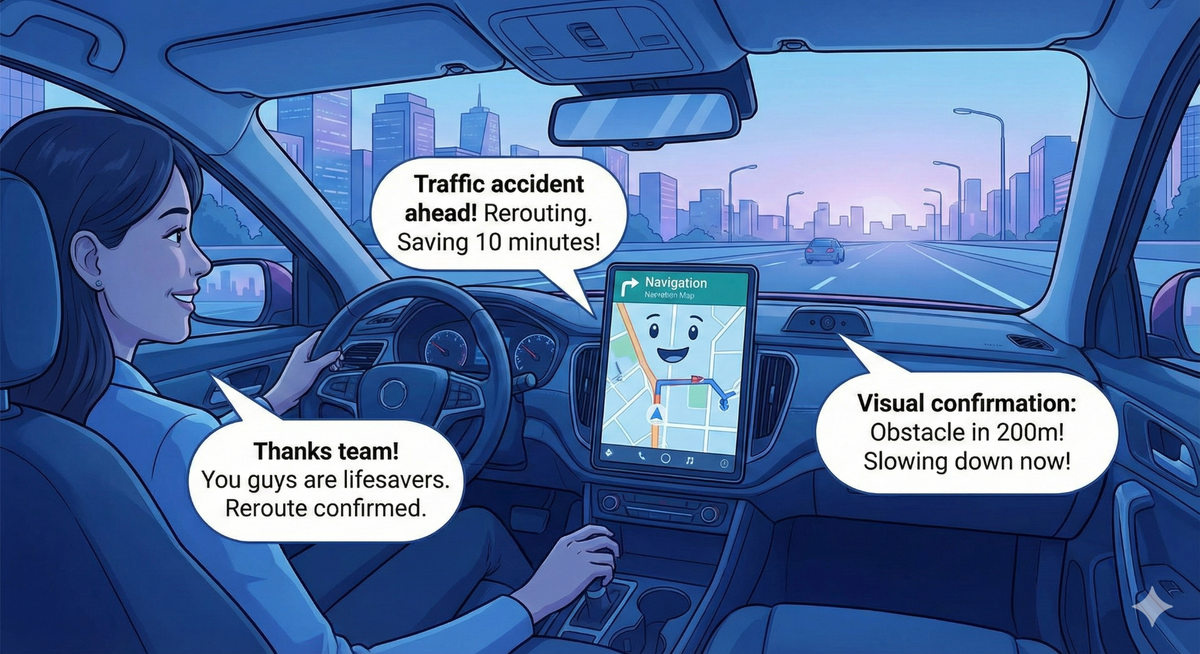
Google is bridging the gap between static map data and the real world by combining vehicle hardware with AI solutions. In complex navigating scenarios like highway exits, GPS alone often fails to pinpoint exactly which lane a car is in. The Polestar 4, powered by Google built-in, uses the vehicle’s front-facing camera to “see” the lanes in real-time, determine its position, and cross-reference it with map data. If the driver is in a lane that conflicts with the navigation route, the AI acts as an Active Agent, providing audio and visual cues like, “To follow the route, you need to move to the right lane now.”
3. Developer Ecosystem (B2B): The ‘Map Builder Agent’
Google is using its AI models to lower the barriers to map UI development while cleverly funneling users toward its API products.
- Natural Language to Code: Google has applied “vibe coding”—instructing AI to generate code via natural language—to the map development environment. Developers no longer need to scour complex manuals or study every API. By simply typing, “Visualize hotel locations and prices in LA on a map and create a booking window,” the Builder Agent generates a preview and embeddable code instantly.
- A New Sales Funnel: Crucially, this agent doesn’t just write code; it identifies and connects the specific Google Maps Platform APIs needed to implement those features. It automates the sales funnel from “Imagination → AI Generation → Product Purchase.”
Mapbox: ‘Spatial Sense’ for AI
Instead of building its own chatbot, Mapbox is positioning itself as the essential AI Map Infrastructure, helping the world’s LLMs read and understand maps.
- Early Adoption of MCP: Text-based AIs often suffer from hallucinations regarding physical space, such as inaccurate distances or location details. By launching the Mapbox MCP Server, Mapbox allows external AI agents (like Claude or ChatGPT) to call upon its precise location data and APIs in real-time. This provides the necessary Grounding for AI responses.
- Providing Spatial Reasoning: Mapbox’s MCP goes beyond finding a hotel or restaurant (POI); it gives AI a sense of space. A striking example is Isochrones. Instead of the abstract concept of “nearby,” Mapbox provides data on “the area reachable within 15 minutes under current traffic.” An AI agent can interpret this to tell a delivery platform, for instance, “This order cannot be delivered within 20 minutes,” or help a real estate AI recommend “listings strictly within a 30-minute commute.”
TomTom: The Driver’s ‘Dedicated Co-pilot’
TomTom focuses on the Digital Cockpit experience tailored for OEMs (Car Manufacturers) and Drivers, rather than broad consumer services. Its alliance with Microsoft (Azure OpenAI) strengthens its touchpoints with enterprise clients.
- Driving-Centric AI: The TomTom AI Agent integrates navigation with vehicle control. It can process natural language commands in a single flow, such as, “I’m low on gas, let’s stop at a cheap station on the way. And open the window.” The core value is a ‘Zero-Touch’ interface that allows drivers to control functions safely without taking their hands off the wheel.
- White-label Strategy: Unlike competitors that might take over the dashboard interface, TomTom supports OEMs in embedding powerful AI capabilities while retaining their own brand identity. The partnership with Microsoft Cloud also ensures enterprise-grade data security and processing speed.
From ‘Click’ to ‘Conversation’: From Searching to Solving
The Global Top 3 map companies all recognize that the era of “Search and View” is fading, replaced by tools that “Solve and Do.”
- Google is locking users into its ecosystem by turning the map into a Personal Assistant and simplifying development tools. As seen with Polestar, maps are now gaining “eyes” (cameras) to see reality.
- Mapbox is turning the map into code that AI can read, aiming to become the indispensable infrastructure for all AI services.
- TomTom is turning the map into the language of the car, aiming to be the protagonist of the driver’s seat.
In the previous era, the competition was about who could update map information faster and more accurately (a task that remains important). However, in the age of AI Agents, the victory will go to whoever best understands the user’s Context and can Generate the desired result instantly.